

Designing an enterprise network for a modern office requires a balance between high availability, security, and scalability. Most professional environments follow a “Hierarchical Design Model” to ensure that a failure in one area doesn’t bring down the entire company.
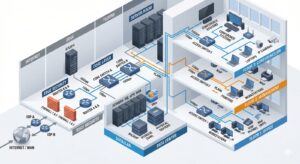
1. The Core Infrastructure (The Backbone)The network is typically divided into three functional layers to manage traffic efficiently:Core Layer: The high-speed backbone of the network. It’s designed for lightning-fast switching and should have no “bottleneck” services (like packet filtering) that slow it down.Distribution Layer: This acts as the bridge. It implements routing, quality of service (QoS), and security policies (ACLs) before traffic hits the core.Access Layer: This is where devices (PCs, VoIP phones, printers) actually connect to the network via switches.
2. Key ComponentsTo maintain “HD quality” performance and uptime, the following components are standard:Security & PerimeterNext-Generation Firewalls (NGFW): Positioned at the edge
3. Redundancy StrategyAn enterprise-grade network is defined by its ability to stay up during a crisis. This is achieved through:Dual ISPs: Using two different internet providers (e.g., Fiber and Satellite/Coax) so if one goes down, the office stays connected.Redundant Power: Uninterruptible Power Supplies (UPS) and backup generators for the server room.Link Aggregation: Combining multiple network cables into one logical link to increase bandwidth and provide a backup path.
4. Logical FlowTraffic typically flows from the End User Device ⇨ Access Switch ⇨ Distribution Switch ⇨ Core Switch ⇨Firewall ⇨ Internet.For internal requests, the traffic hits the Core Switch and is routed directly to the Data Center servers, keeping “local” traffic off the internet gateway to maximize speed.