

Challenges in Campus area blindspots
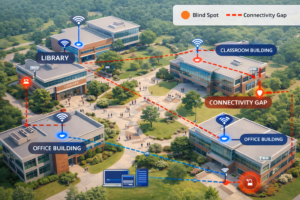
Simplified solution
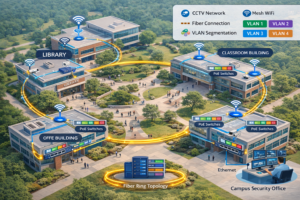
Campus networks connect multiple buildings and departments within a limited area, like universities or corporate sites, using interconnected LANs for reliable access to resources. They follow a hierarchical design to ensure scalability, security, and performance for users such as students or staff.
The core architecture and design principles.
1. The Hierarchical Design Model
Most modern campus networks follow the Cisco Three-Tier Model. This structure ensures the network is modular, easy to scale, and simple to troubleshoot.
Core Layer: The “backbone.” Its only job is to switch traffic as fast as possible between different distribution blocks.
Distribution Layer: The “bridge.” This is where policy-based connectivity happens. It handles routing, filtering, and WAN access.
Access Layer: The “edge.” This is where end-users (laptops, phones, APs) connect to the network.
“The proposed campus network architecture utilizes a resilient, three-tier hierarchical design to provide seamless, high-speed connectivity across all academic and residential facilities. By integrating robust security protocols at the access layer and high-capacity fiber optics at the core, the infrastructure is designed to support high-density wireless demands, diverse IoT integrations, and mission-critical administrative services with 99.99% uptime.”