

A hospital network is one of the most complex environments in IT, requiring a “zero-failure” approach Because patients lives often depend on the immediate availability of data—from real-time vitals to massive MRI files—the design must be exceptionally robust, secure, and fast.
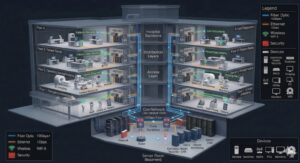
The core components and considerations for a modern hospital network:
1. The Three-Tier Hierarchy
Modern hospital networks usually follow a structured Cisco-style hierarchical model to ensure traffic flows efficiently and faults are contained.
Core Layer: The “heart” of the network. High-speed switches (like the Catalyst 9500 series) handle the massive data throughput between different buildings or large departments. It focuses on pure speed and reliability.
Distribution Layer: This layer acts as the bridge. It implements routing, filtering, and security policies. It ensures that if one “closet” goes down, the rest of the hospital remains unaffected.
Access Layer: This is where devices actually connect. It includes the switches in various wings that provide Power over Ethernet (PoE) for VoIP phones, Wireless Access Points (WAPs), and security cameras.
2. Critical Network Services
A hospital network isn’t just about internet access; it hosts specialized services that require high bandwidth and low latency:
PACS (Picture Archiving and Communication System): This handles medical imaging like X-rays and MRIs. These files are enormous. Without a 10Gbps or 40Gbps backbone, a doctor might wait minutes for an image to load—time they don’t always have.
EHR/EMR (Electronic Health Records): The database where all patient history lives. This requires constant uptime and strict encryption to meet HIPAA or GDPR standards.
IoMT (Internet of Medical Things): This includes “smart” beds, infusion pumps, and heart monitors. These devices often have weak built-in security, so they are typically isolated on their own VLAN (Virtual LAN) to prevent them from being used as entry points for hackers.
3. Redundancy and High Availability
In a hospital, “five nines” (99.999%) uptime is the goal.
Physical Redundancy: Every core switch and major router should have a “twin.” If Switch A fails, Switch B takes over instantly via protocols like HSRP or VRRP.
Path Redundancy: Fiber optic cables should take different physical paths through the building. If a construction crew accidentally cuts a cable in the North Wing, data should automatically reroute through the South Wing.
4. Security: The “Vault” Approach
Hospitals are prime targets for ransomware. Security is layered:
Micro-segmentation: Even if a guest’s laptop on the “Guest Wi-Fi” is infected with a virus, the network architecture prevents that virus from “seeing” or “jumping” to the surgical floor’s network.
Firewalls and IPS: Next-Generation Firewalls (NGFW) sit at the edge and between internal segments to inspect traffic for suspicious patterns in real-time.
NAC (Network Access Control): Systems like Cisco ISE ensure that only authorized devices can plug into a wall jack. If an unknown laptop is plugged in, the port automatically shuts down.
5. Wireless Infrastructure
Wireless isn’t just a convenience; it’s a clinical tool.
Wi-Fi 6/6E: Essential for handling the high density of devices in a small area.
RTLS (Real-Time Location System): Uses the Wi-Fi network to track the location of expensive mobile equipment (like ventilators or crash carts) so staff don’t waste time searching for them during an emergency.